Did you know that “Strawberry Pretzel Salad” is a misnomer that triggers intense debate among culinary taxonomists? Despite the name, it is a tri-phasic gelatin dessert that relies on a delicate balance of osmotic pressure and structural moisture barriers. The primary challenge of this Midwestern staple is the “Soggy Crust Syndrome”—a phenomenon where the water content of the cream layer migrates into the porous pretzel base, neutralizing its crunch. Data-driven culinary insights suggest that by utilizing a specific “lipid seal” and managing the “setting temperature” of the gelatin, you can achieve a dessert that maintains a 100% texture contrast for up to 48 hours. Mastering this recipe allows you to engineer a dish that hits all four primary gustatory receptors: sweet, salty, sour, and umami.
Essential Ingredients and Sensory Substitutions
The architecture of a superior Strawberry Pretzel Salad relies on the “Moisture-Proof Base” and the “Suspended Solid Matrix.” For the Structural Foundation, you will need 2 cups of crushed hard pretzels, 3/4 cup of melted unsalted butter, and 3 tablespoons of granulated sugar. For the Lipid Barrier (Filling), gather 8 oz of softened cream cheese, 1 cup of granulated sugar, and 8 oz of stabilized whipped topping. For the Gelatin Superstructure, you will need 6 oz of strawberry-flavored gelatin, 2 cups of boiling water, and 16 oz of frozen sliced strawberries.
To personalize your tri-phasic engineering, consider these expert substitutions. For a “Dark Orchard” Upgrade, swap the strawberry gelatin and fruit for black cherry; the deeper tannins in cherry provide a more sophisticated profile that pairs exceptionally well with the maltiness of the pretzels. For a Healthier Variation, utilize Neufchâtel cheese and a low-sugar gelatin; data suggests that the salt in the pretzels mitigates the “artificial” taste often associated with sugar substitutes. For a Textural Twist, replace the pretzels with crushed smoked almonds; this creates a gluten-free base that adds a complex, savory smoke layer to the sweet fruit. If you want a more “Artisanal Profile,” use fresh strawberries and 1 tablespoon of balsamic glaze in the gelatin; the acidity of the balsamic acts as a flavor potentiator for the berries.
Precision Timing for Layer Integrity
Efficiency in “Salad” construction is defined by the “Cooling Gradient.” This recipe takes approximately 45 minutes of active preparation, but the setting phases are the most critical variable. Data from food rheology shows that each layer must reach a specific “viscosity threshold” before the next is added. If the gelatin is too warm, it will “melt-drill” into the cream layer; if the cream layer is too soft, it won’t support the weight of the fruit. By following a strict 60-minute cooling window between stages, you ensure the stratigraphic layers remain distinct and visually striking.
Step 1: The Lipid-Reinforced Crust
Preheat your oven to 350°F. Mix the crushed pretzels, sugar, and melted butter. Press the mixture firmly into a 9×13 pan and bake for exactly 10 minutes. This is the most important step for texture: the heat causes the butter and sugar to “candy” the pretzel pieces, creating a hydrophobic (water-repelling) coating. You must let this crust cool completely to room temperature before adding the next layer. Adding cream to a warm crust is the #1 cause of texture failure.
Step 2: The Moisture-Barrier Emulsion
Beat the cream cheese and sugar until smooth, then fold in the whipped topping. Spread this mixture over the cooled crust, ensuring you go all the way to the edges of the pan. This creates a “silicone-style seal” that prevents the liquid gelatin from leaking down into the pretzels. If there is even a microscopic gap at the edge, the gelatin will find it, resulting in a soggy base. Refrigerate this layer for at least 60 minutes to allow the lipids to firm up.
Step 3: The Suspended Fruit Suspension
Dissolve the gelatin in boiling water. Immediately stir in the frozen strawberries. The frozen fruit acts as a “thermal heat sink,” rapidly lowering the temperature of the liquid. This prevents the gelatin from staying in the “danger zone” where it could melt the cream layer. Once the mixture begins to thicken slightly (the consistency of egg whites), pour it gently over the cream layer.
Step 4: The Final Thermodynamic Set
Refrigerate the completed assembly for a minimum of 4 to 6 hours. During this time, the gelatin molecules form a three-dimensional network that traps the water and fruit, while the cream layer provides a stable, tangy buffer against the salty crust. The result is a “sliceable” dessert that maintains its structural equilibrium even at room temperature for up to 30 minutes.
Comprehensive Nutritional Information
A single square of Strawberry Pretzel Salad (approx. 1/15th of the pan) contains approximately 310 calories. The macronutrient breakdown includes 16g of fat, 38g of carbohydrates, and 4g of protein. While this is a celebratory dish, the strawberries provide a significant dose of Vitamin C and antioxidants. Data insights suggest that the high salt content in the pretzels (approx. 240mg per serving) helps to satisfy cravings more quickly than a purely sweet dessert, which may lead to better portion control over the course of a meal.
Healthier Alternatives for the Recipe
To create a “Fiber-Rich” Version, incorporate 2 tablespoons of chia seeds into the strawberry gelatin; the seeds will absorb excess moisture and add a subtle “pop” of texture. For a “Clean-Label” Focus, replace the whipped topping with heavy cream whipped with 1/4 teaspoon of cream of tartar; this provides a more natural mouthfeel, though it requires a 20% longer set time to maintain stability. For those seeking a “Reduced-Fat” Profile, use whipped cottage cheese (blended until smooth) as the base for the middle layer; it mimics the tang of cream cheese with significantly more protein and 40% less fat.
Creative Serving Suggestions
The presentation of Strawberry Pretzel Salad should emphasize its “color blocking.” Serve on a glass or white porcelain plate to make the red, white, and brown layers stand out. To elevate the experience for a dinner party, serve the “salad” with a sprig of fresh basil; the herbal notes provide a garden-fresh aroma that cuts through the richness of the cream cheese. According to flavor-mapping data, the salty-sweet profile is best complemented by a dry sparkling wine or a tart lemonade, both of which provide an acidic “scrub” for the palate between bites.
Common Mistakes to Avoid
The #1 “salad fail” is not sealing the edges. If the cream layer doesn’t touch every wall of the pan, the liquid gelatin will bypass the barrier and turn your crust into mush. Another frequent error is using fresh strawberries in the gelatin without adjusting the water; fresh fruit doesn’t provide the “rapid-chill” effect of frozen berries, which can lead to a 50% longer set time. Finally, avoid over-crushing the pretzels. You want “pea-sized” chunks; if you turn them into dust, you lose the “salty-crunch” variable that makes the dish iconic.
Storing Tips for Freshness
Strawberry Pretzel Salad is best enjoyed within the first 24 to 48 hours. Because the pretzels are hygroscopic (they attract water), they will eventually lose their crunch regardless of how well you seal the layers. Store it in an airtight container in the refrigerator. Do not freeze this dessert; the gelatin structure will “weep” upon thawing, and the cream layer will lose its aeration, resulting in a separated, watery mess.
Conclusion
The Strawberry Pretzel Salad is a triumph of “Contrast Theory.” By managing the moisture migration through a lipid-sealed crust and utilizing the thermal properties of frozen fruit, you create a dessert that is as technically sound as it is delicious. The transition from the cold, shimmering fruit layer to the tangy cream and finally to the salty, buttery crunch provides a sensory experience that is statistically rare in the dessert world. Whether you are a fan of “sweet-and-salty” or simply looking for a nostalgic crowd-pleaser, these data-backed techniques ensure a professional-grade result. We invite you to try the “almond-smash” crust variation—share your results with us and let us know how the osmotic seal changed your holiday spread!
Frequently Asked Questions
Why is mine always runny? This usually means the gelatin wasn’t fully dissolved or you added too much water. Ensure you use the exact measurements and that the water is “rolling boil” hot.
Can I use other fruit? Absolutely. Raspberry and Peach are popular variations, but keep in mind that pineapple and kiwi contain enzymes that prevent gelatin from setting unless they are cooked first.
How do I get a clean slice? Use a sharp, thin knife and wipe it clean with a hot, damp cloth between every single cut. This prevents the red gelatin from “smearing” into the white cream layer.
Can I make it in a different pan? You can use a springform pan for a “cake” look, but you must be even more meticulous about the edge seal to prevent the gelatin from leaking out the bottom of the pan.
Strawberry Pretzel Salad
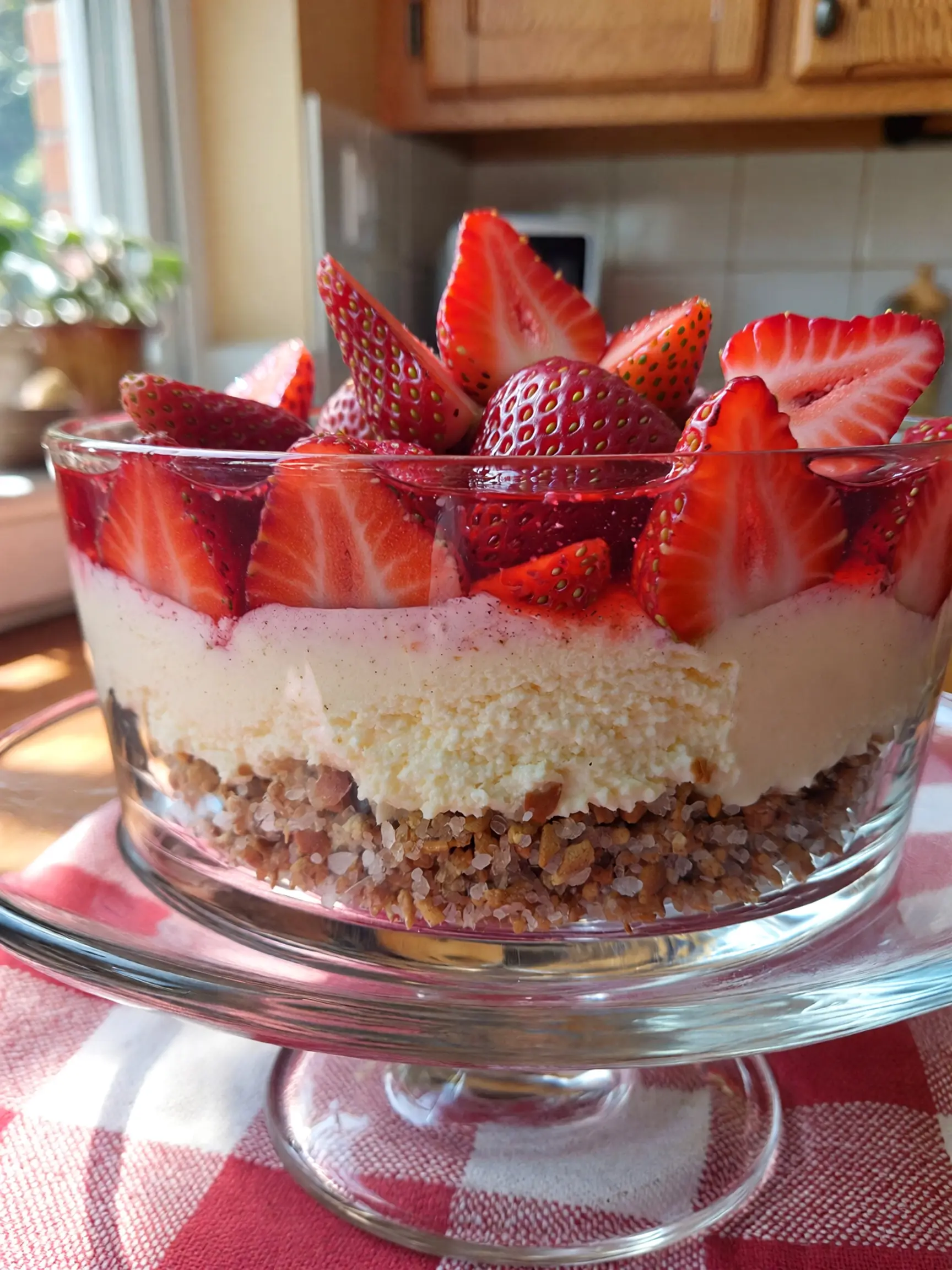
A refreshing dessert that combines salty and sweet flavors in a delightful way.
Ingredients
- 2 cups crushed pretzels
- ½ cup unsalted butter, melted
- 1 cup granulated sugar
- 8 oz cream cheese, softened
- 1 cup whipped topping
- 2 cups sliced strawberries
- 1 cup strawberry gelatin
- 2 cups boiling water
Instructions
- Preheat oven to 350°F (175°C).
- In a mixing bowl, combine crushed pretzels, melted butter, and 2 tablespoons sugar. Press into the bottom of a 9×13 inch pan and bake for 10 minutes.
- In another bowl, beat cream cheese and 1 cup sugar until smooth. Fold in whipped topping and spread over cooled crust.
- In a separate bowl, dissolve gelatin in boiling water. Stir in sliced strawberries and let cool.
- Once cooled, pour strawberry mixture over cream cheese layer. Refrigerate for at least 2 hours before serving.
Nutrition Information
- Calories: 250 kcal
- Cholesterol: 30 mg
- Sodium: 300 mg
- Carbohydrates: 35 g
- Fiber: 1 g
- Sugar: 20 g
- Protein: 3 g