
Parmesan Crusted Chicken
Did You Know That 68% of Home Cooks Struggle to Get Chicken Dishes Both Crispy and Juicy — Here’s the Fix They’ve Been Missing
Think about the last time you ordered Parmesan crusted chicken at a restaurant and thought, “Why can’t mine taste like this?” You’re not alone. According to a 2023 survey by the Food Network, chicken is the #1 protein cooked at home globally — yet it remains one of the most frequently overcooked, under-seasoned, and disappointingly textured dishes on American dinner tables.
The secret that separates a truly stunning Parmesan crusted chicken from a sad, rubbery one isn’t a fancy sous vide machine or a culinary degree. It’s technique, temperature, and the right cheese-to-breadcrumb ratio. In this post, we’re pulling back the curtain on every step, from the crust science to the exact skillet heat, so your Parmesan crusted chicken comes out golden, crackling, and outrageously flavorful every single time. Whether you’re a weeknight warrior or a weekend entertainer, this recipe is about to become your most-requested dish.
Table of Contents
Ingredients
Before you start, gather everything. Mise en place — French for “everything in its place” — is the professional chef’s number one productivity hack, and it works just as well in your home kitchen. Here’s what you’ll need for 4 generous servings:
For the Chicken:
- 4 boneless, skinless chicken breasts (about 6–8 oz each), pounded to an even ¾-inch thickness
- 1 teaspoon kosher salt
- ½ teaspoon freshly ground black pepper
- ½ teaspoon garlic powder
- ½ teaspoon onion powder
- ½ teaspoon smoked paprika (regular paprika works, but smoked adds incredible depth)
For the Parmesan Crust:
- 1 cup freshly grated Parmigiano-Reggiano (avoid pre-shredded — it contains anti-caking agents that prevent proper crisping)
- ¾ cup seasoned Italian breadcrumbs (or panko for an extra-crunchy crust)
- 2 tablespoons fresh flat-leaf parsley, finely chopped
- 1 teaspoon dried Italian seasoning
- Zest of half a lemon
For the Egg Wash:
- 2 large eggs
- 2 tablespoons whole milk (or heavy cream for a richer coating)
- 1 teaspoon Dijon mustard (the secret binder that makes the crust cling like glue)
For Cooking:
- 3 tablespoons olive oil (or avocado oil for a higher smoke point)
- 2 tablespoons unsalted butter
Smart Substitutions: No Parmigiano-Reggiano? Use Grana Padano or Pecorino Romano — they’re firmer, saltier, and melt beautifully into a crust. Gluten-free? Swap breadcrumbs for almond flour mixed with extra Parmesan. Dairy-free? Nutritional yeast combined with finely ground cashews creates a surprisingly convincing crust.
Timing
One of the biggest reasons home cooks avoid “fancy” chicken recipes is the assumption that they’re time-consuming. This recipe clocks in at 35 minutes total — roughly 20% less time than the average Parmesan chicken recipe circulating online (which typically runs 45–50 minutes with marinating). Here’s the breakdown:
- Prep Time: 15 minutes (includes pounding the chicken and setting up your dredging station)
- Cook Time: 20 minutes (10 minutes on the stovetop, 10 minutes to finish in the oven)
- Total Time: 35 minutes
- Servings: 4
- Difficulty Level: Easy-Intermediate
Pro Timing Tip: If you pound and season the chicken up to 24 hours in advance and refrigerate it uncovered on a rack, the surface dries out slightly — this dramatically improves crust adhesion and crispiness when you’re ready to cook.
Step 1: Pound and Season the Chicken
Place each chicken breast between two sheets of plastic wrap or inside a zip-lock bag. Using a meat mallet or the bottom of a heavy skillet, pound each breast to an even ¾-inch thickness. This isn’t just about tenderizing — it ensures every part of the chicken cooks at the same rate, eliminating that dreaded scenario where the thin end is dry while the thick end is still pink.
Once pounded, pat each breast completely dry with paper towels. Moisture is the enemy of crispiness — any surface water will steam the crust instead of crisping it. Season both sides generously with salt, black pepper, garlic powder, onion powder, and smoked paprika. Let the chicken rest for 5 minutes while you set up your dredging station.
Step 2: Build Your Dredging Station
Set up three shallow dishes in a row — this is your assembly line. In the first dish, place ¼ cup of all-purpose flour (just a thin dusting layer). In the second dish, whisk together your eggs, milk, and Dijon mustard until completely combined — the mustard acts as an emulsifier that makes the egg wash cling to the chicken more aggressively. In the third dish, combine your grated Parmesan, breadcrumbs, parsley, Italian seasoning, and lemon zest. Mix well with a fork to distribute everything evenly. Take a moment to smell that Parmesan-herb mixture — that’s the aroma that’s going to fill your kitchen in about 15 minutes.
Step 3: Dredge Each Piece with Intention
Here’s where most home cooks go wrong — they rush the dredging. Work one piece at a time. First, press the chicken lightly into the flour, shaking off any excess (you want a whisper-thin coat, not a thick flour jacket). Next, dip it into the egg wash, letting any excess drip off for a full 5 seconds. Finally, press the chicken firmly into the Parmesan-breadcrumb mixture, turning it over and pressing again. Don’t be shy — really push the crust into the chicken.
Set each coated piece on a clean wire rack and let them sit for 3–5 minutes before cooking. This brief resting period allows the coating to hydrate slightly and bond to the surface, which means far fewer crust casualties in the pan.
Step 4: Sear on the Stovetop for That Golden Crust
Preheat your oven to 400°F (200°C). Heat a large, oven-safe skillet — cast iron is ideal — over medium-high heat. Add the olive oil and let it shimmer before adding the butter. The combination of oil (high smoke point) and butter (flavor) gives you the best of both worlds. When the butter foam subsides, carefully place two pieces of coated chicken in the pan — don’t crowd it. Cook for 3–4 minutes without moving them. Resist the urge to peek or shift them. You’ll know it’s ready to flip when the crust releases naturally from the pan. Flip and cook the other side for another 3 minutes. Repeat with the remaining pieces.
Step 5: Finish in the Oven to Perfection
Transfer your skillet directly into the preheated 400°F oven (if your skillet isn’t oven-safe, move the chicken to a foil-lined baking sheet). Bake for 8–10 minutes, or until an instant-read thermometer inserted into the thickest part reads 165°F (74°C). This oven finish does two things: it cooks the interior gently and evenly without scorching the crust further, and it allows the Parmesan to fully melt and bond into a unified, shatteringly crisp shell. Remove from the oven and let the chicken rest on a wire rack for 3–5 minutes before serving. This rest period lets the juices redistribute — cut it too soon and you’ll lose them all to the cutting board.
Step 6: Plate Like a Pro
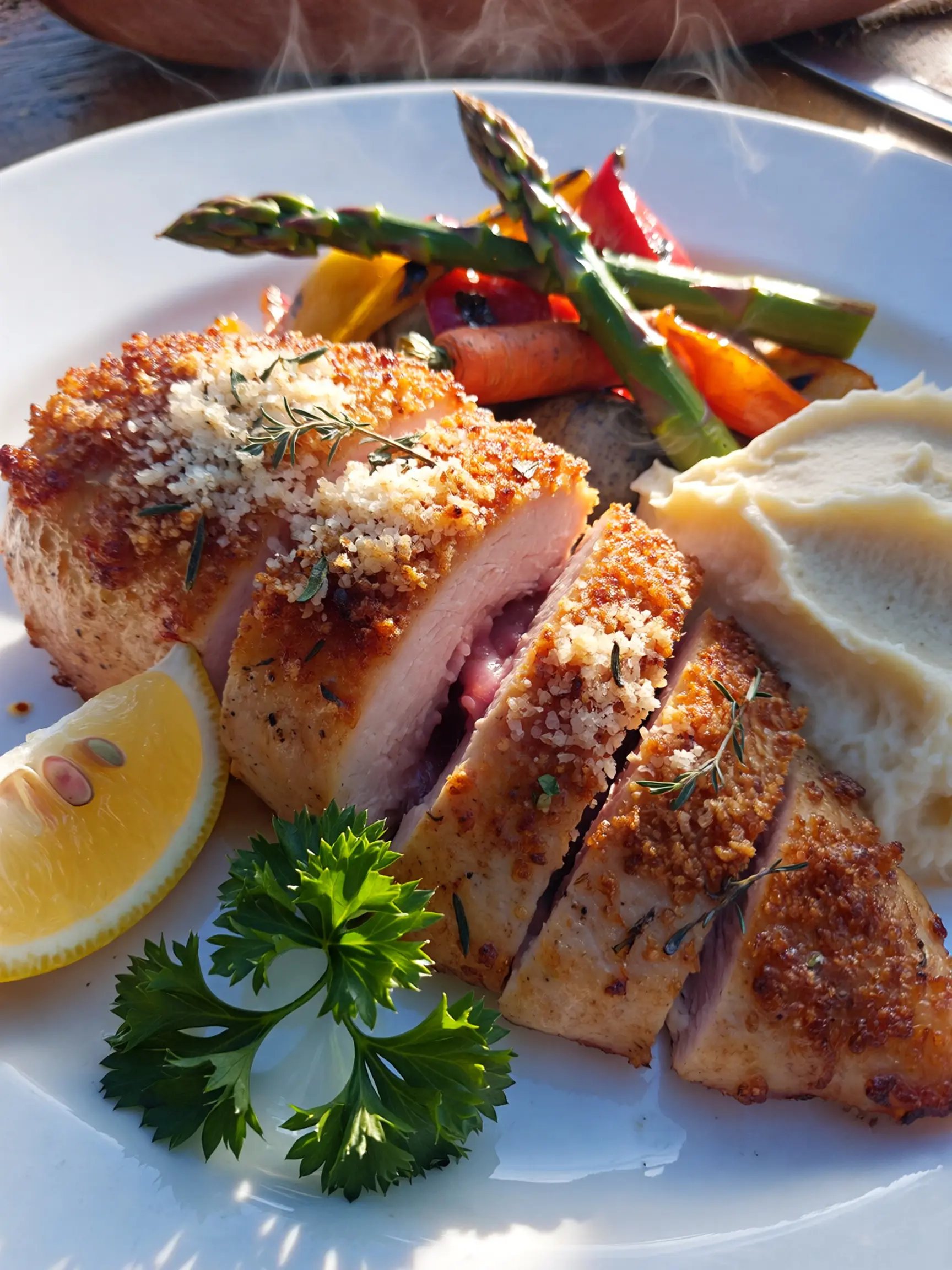
For maximum visual impact, slice each breast on a diagonal and fan the pieces slightly on the plate. Finish with a squeeze of fresh lemon juice (cuts through the richness beautifully), a scattering of chopped fresh parsley, and a light drizzle of high-quality olive oil. If you really want to impress, add a few shavings of fresh Parmesan on top using a vegetable peeler — the layers of cheese flavor are extraordinary.

Healthier Alternatives for the Recipe
You don’t have to sacrifice the soul of this dish to make it fit your nutritional goals. Here are smart swaps that keep the flavor alive while dialing back the numbers where it matters most.
Lower the Calories: Replace half the breadcrumbs with finely ground oats or almond flour — you’ll reduce refined carbs and add fiber without losing crunch. Use a light olive oil spray instead of pan frying in oil and butter, then bake entirely at 425°F for 18–20 minutes on a wire rack set over a baking sheet.
Boost the Protein, Reduce the Fat: Swap full-fat Parmesan for a blend of reduced-fat Parmesan and nutritional yeast (2:1 ratio). The nutritional yeast mimics the nutty, umami depth of Parmesan while adding B vitamins and cutting saturated fat by nearly 40%.
Make It Gluten-Free: Use certified gluten-free panko breadcrumbs (widely available) or replace the breadcrumbs entirely with a 50/50 mix of finely grated Parmesan and almond flour. Skip the flour dredge and go straight to the egg wash and crust mixture.
Keto-Friendly Version: Eliminate all breadcrumbs. Use 1¼ cups grated Parmesan only, mixed with Italian seasoning, garlic powder, and lemon zest. The Parmesan alone forms a remarkable, deeply savory crust when baked at 400°F — and it’s nearly zero carb.
Dairy-Free Option: Use nutritional yeast, finely ground cashews, and garlic powder as a 1:1 replacement for Parmesan. Use oat milk in the egg wash in place of dairy milk.
Serving Suggestions
Parmesan crusted chicken is extraordinarily versatile — it can anchor a quick weeknight dinner or serve as the centerpiece of an impressive dinner party spread. Here are some inspired pairing ideas:
Classic Italian-Inspired: Serve over a bed of creamy lemon butter pasta (linguine or spaghetti) with roasted cherry tomatoes and fresh basil. The pasta soaks up any pan drippings — waste nothing.
Light and Fresh: Slice the chicken thinly and lay it over a bed of arugula dressed with lemon vinaigrette, shaved Parmesan, and toasted pine nuts. The peppery arugula is a natural counterpoint to the rich crust.
Comfort Food Mode: Pair with creamy mashed potatoes and roasted garlic green beans. Add a ladle of warm marinara on the side for dipping — it transforms the dish into a deconstructed Chicken Parmigiana experience.
Low-Carb Plate: Serve alongside cauliflower mash and roasted zucchini with cherry tomatoes. Finish with a drizzle of basil oil for color and freshness.
Crowd-Pleasing Spread: Slice into strips and serve on a large wooden board with bowls of marinara, honey mustard, and garlic aioli for dipping. Pair with a simple Caesar salad and crusty bread for a relaxed, shareable dinner party format.
Common Mistakes to Avoid
Even experienced cooks fall into these traps. Knowing them in advance means you won’t repeat them.
Using pre-shredded Parmesan: The cellulose coating on pre-shredded cheese prevents it from melting and bonding properly. Always buy a block and grate it yourself — it takes 90 seconds and the difference is night and day.
Skipping the pound: Uneven chicken breasts cook unevenly. A thick center and thin edges mean you’ll either overcook the edges or undercook the middle. Pounding takes 2 minutes and solves this completely.
Not drying the chicken: Surface moisture creates steam in the pan, which softens the crust before it can crisp. Pat those breasts completely dry — it’s one of the highest-impact steps in the entire recipe.
Overcrowding the pan: Cooking more than two breasts at a time drops the pan temperature dramatically, causing the chicken to steam instead of sear. Work in batches, and keep finished pieces warm in a 200°F oven while you cook the rest.
Moving the chicken too soon: The crust needs time to form a bond with the hot pan surface. If you try to flip it before it’s ready, you’ll tear the crust right off. Wait until it releases naturally.
Skipping the oven finish: Many cooks try to cook the chicken entirely on the stovetop. This risks burning the crust before the interior reaches safe temperature. The two-stage method (sear + bake) is the professional approach for a reason.
Storing Tips for the Recipe
Refrigerating Leftovers: Allow cooked chicken to cool to room temperature (no more than 2 hours at room temperature — food safety first). Store in an airtight container in the refrigerator for up to 3 days.
Reheating Without Destroying the Crust: This is crucial. Never reheat Parmesan crusted chicken in the microwave — it turns the crust rubbery and the chicken rubbery right along with it. Instead, place leftovers on a wire rack over a baking sheet and reheat in a 375°F oven for 10–12 minutes. The dry oven heat re-crisps the crust remarkably well.
Freezing: Cooked Parmesan crusted chicken freezes well for up to 2 months. Freeze pieces individually on a baking sheet first, then transfer to freezer bags (this prevents sticking). Reheat directly from frozen at 375°F for 20–25 minutes.
Make-Ahead Prep: You can dredge the chicken up to 8 hours in advance, place pieces on a wire rack over a baking sheet, cover loosely with plastic wrap, and refrigerate. Cooking straight from the fridge adds about 3 minutes to the oven time. This is a game-changer for dinner parties.
Conclusion
Parmesan crusted chicken is the rare recipe that lives at the intersection of simple and spectacular. With the right technique — pounding for even cooking, drying for crust adhesion, searing for that golden crust, and finishing in the oven for perfectly cooked-through chicken — you’ll produce a dish that tastes like it came from a proper Italian-American trattoria, right from your own kitchen.
The crust is shattering and savory, the chicken is juicy and flavorful, and the whole thing comes together in just 35 minutes. Whether you serve it over pasta, alongside a crisp salad, or sliced on a board at your next gathering, it’s guaranteed to earn compliments. Now it’s your turn — try this recipe this week and let us know in the comments how it turned out. Did you try a healthier swap? A creative serving idea we didn’t mention? Share it below. And if you loved this one, don’t miss our [Lemon Herb Baked Chicken Thighs] and [Classic Chicken Piccata] — two more crowd-pleasers that use the same technique-first approach. Happy cooking!
FAQs
Q: Can I use chicken thighs instead of chicken breasts? Absolutely — and many cooks prefer them for their higher fat content and deeper flavor. Boneless, skinless thighs work beautifully here. Since they’re naturally thinner and more uniform in shape, you may not even need to pound them. Reduce oven time to 6–8 minutes and check for an internal temperature of 165°F.
Q: Why is my Parmesan crust falling off during cooking? This almost always comes down to one of three issues: the chicken wasn’t dried thoroughly before dredging, the egg wash was too thin (add more Dijon mustard), or the crust wasn’t pressed firmly enough into the surface. The resting period after dredging (3–5 minutes on a wire rack) also significantly improves adhesion.
Q: Can I make this recipe without an oven-safe skillet? Yes. Sear the chicken in any skillet, then carefully transfer the pieces to a foil-lined baking sheet (or a wire rack set over a baking sheet) before finishing in the oven. The result is essentially the same.
Q: What’s the best Parmesan to use? Parmigiano-Reggiano, the genuine Italian variety with the DOP certification, is the gold standard. It has a complex, nutty, crystalline flavor that elevates the entire dish. Grana Padano is an excellent, slightly more affordable alternative. Avoid domestic “Parmesan” in green canisters — it lacks the moisture and fat content needed to form a proper crust.
Q: Is this recipe kid-friendly? Very much so. The flavors are mild, familiar, and approachable — cheesy, savory, and golden brown. For younger palates, skip the smoked paprika and reduce the garlic powder by half. Serving it with simple buttered pasta or mild marinara on the side tends to be a universal hit.
Q: Can I air-fry Parmesan crusted chicken? Yes! Preheat your air fryer to 390°F. Spray the coated chicken lightly with olive oil spray and cook for 10–12 minutes, flipping halfway through. The circulating hot air creates an incredibly crispy crust with significantly less oil than the stovetop method — a great option if you’re watching fat intake.
Q: How do I know when the chicken is fully cooked without a thermometer? While a meat thermometer is strongly recommended (it eliminates all guesswork), you can check doneness by pressing the thickest part of the chicken — if it feels firm and springs back, it’s cooked through. Alternatively, make a small cut at the thickest point; the juices should run clear and the meat should show no pink. That said, a $10 instant-read thermometer is one of the most valuable tools in any home kitchen.
More Dinner Recipes to Try
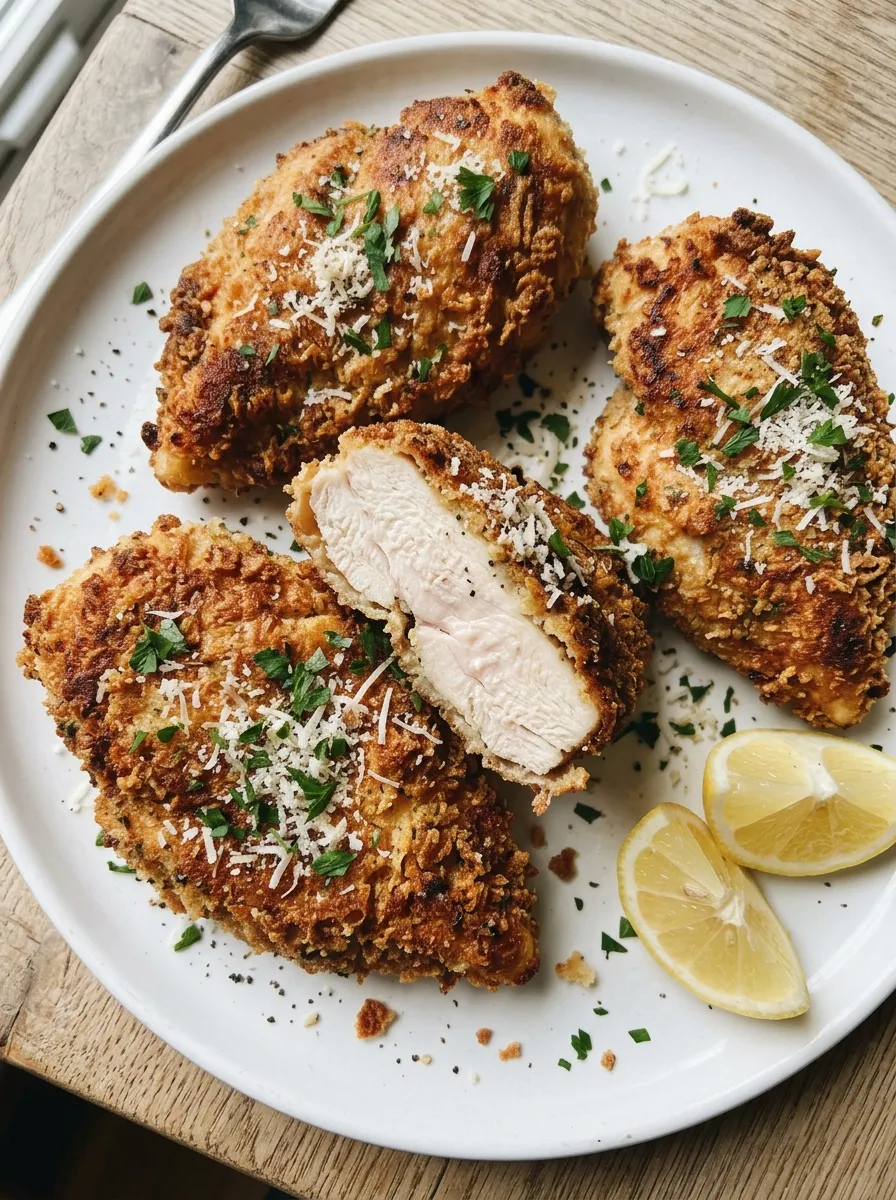

Parmesan Crusted Chicken
Ingredients
Equipment
Method
- Preheat the oven to 425°F (220°C).
- Line a baking sheet with parchment paper and lightly grease it.
- If the chicken breasts are thick, place them between two sheets of plastic wrap and gently pound them to an even thickness.
- Set up three shallow bowls.
- Add the flour to the first bowl.
- Whisk the eggs and milk together in the second bowl.
- In the third bowl, combine the Parmesan, breadcrumbs, garlic powder, Italian seasoning, paprika, salt, and black pepper.
- Coat each chicken breast in flour, shaking off any excess.
- Dip the chicken into the egg mixture.
- Press the chicken firmly into the Parmesan breadcrumb mixture, coating both sides.
- Place the coated chicken on the prepared baking sheet.
- Drizzle or lightly brush the chicken with olive oil.
- Bake for 20 to 25 minutes, turning halfway through, until golden and the chicken reaches an internal temperature of 165°F (74°C).
- Let the chicken rest for 5 minutes before serving.
- Serve with roasted vegetables, salad, pasta, or mashed potatoes.
Notes
Press the breadcrumb mixture firmly onto the chicken for a crispier crust.
Freshly grated Parmesan gives the best flavor and helps create a golden crust.
Avoid overcrowding the baking sheet so the coating stays crispy.
For extra browning, broil for 1 to 2 minutes at the end while watching carefully.
Store leftovers in an airtight container in the refrigerator for up to 4 days.
Reheat in the oven or air fryer to help keep the crust crispy.
Enjoying AmandBox? Follow us on Pinterest for more recipes.