
Yogurt Parfaits
Here is a statistic that frames the conversation perfectly: according to the International Dairy Foods Association, Greek Yogurt Parfaits consumption in the United States has grown by over 900% in the past fifteen years — from a niche specialty product to a $4.5 billion industry — and the single most popular way Americans consume it, according to Nielsen consumer data, is in a layered parfait format. Not in a smoothie. Not as a dip. In a parfait, layered with granola and fruit, eaten for breakfast, snack, or dessert across every demographic from competitive athletes to school-aged children.
The reason is not complicated. A yogurt parfait done correctly is one of the most nutritionally complete, texturally satisfying, visually appealing, and genuinely delicious things you can put together in under five minutes. It provides complete protein from the yogurt, complex carbohydrates and fiber from the granola, antioxidants and vitamins from the fresh fruit, and healthy fats if you add nuts or nut butter. It is served cold, requires no cooking, generates minimal cleanup, and looks beautiful enough to serve to guests while being practical enough to make at 7 AM on a Wednesday before work.
Table of Contents
Ingredients
A great yogurt parfait is built from three primary layers and a selection of finishing elements. The quantities below make 4 generous parfaits.
For the Yogurt Base:
- 3 cups (720g) full-fat plain Greek yogurt — the gold standard for parfaits; its thick, creamy texture, high protein content (approximately 17–20 grams per cup), and pleasant tanginess form the ideal foundation for every other element (full-fat produces a noticeably richer, creamier, more satisfying result than non-fat or low-fat varieties, which tend to be watery and excessively tart)
- 2 tablespoons raw honey or pure maple syrup (the yogurt needs just enough sweetening to balance its natural tang without competing with the sweetness of the fruit)
- 1 teaspoon pure vanilla extract
- ½ teaspoon lemon zest (optional — adds a subtle brightness that elevates the yogurt from plain to intentional)
For the Granola Layer:
- 2 cups (200g) granola — homemade is vastly superior to store-bought for reasons detailed below, but a quality store-bought granola with visible whole oats, nuts, and seeds and a short ingredient list is a completely acceptable shortcut
- OR use the homemade granola recipe below, which takes 25 minutes and makes enough for several batches of parfaits
Quick Homemade Granola (makes approximately 4 cups):
- 3 cups (270g) old-fashioned rolled oats
- 1 cup (110g) mixed nuts — almonds, pecans, walnuts, or cashews, roughly chopped
- ¼ cup (35g) raw sunflower seeds or pumpkin seeds
- ¼ cup (55g) coconut oil or neutral vegetable oil, melted
- ⅓ cup (80ml) pure maple syrup or honey
- 1 teaspoon ground cinnamon
- ½ teaspoon fine sea salt
- 1 teaspoon pure vanilla extract
- ½ cup (75g) dried fruit — raisins, dried cranberries, or chopped dried apricots, added after baking
For the Fresh Fruit Layer:
- 1 cup (150g) fresh strawberries, hulled and sliced
- 1 cup (125g) fresh blueberries
- ½ cup (65g) fresh raspberries
- ½ cup (75g) fresh blackberries
- 1 tablespoon fresh lemon juice
- 1 teaspoon honey (optional — enhances the sweetness of berries that are less ripe)
- 1 teaspoon lemon zest
Finishing and Optional Elements:
- 2 tablespoons nut butter — almond, peanut, or cashew — drizzled over the top
- 2 tablespoons honey or maple syrup for finishing drizzle
- Fresh mint sprigs
- Edible flowers — pansies or violas for the most beautiful presentation
- 2 tablespoons chia seeds stirred into the yogurt base for additional fiber and omega-3s
- 2 tablespoons unsweetened shredded coconut, toasted in a dry pan for 2 minutes
- Dark chocolate chips or cacao nibs scattered over the top
- 1 tablespoon bee pollen for an extraordinary finishing touch that adds flavor, protein, and striking visual texture
Smart Substitutions: Dairy-free? Use full-fat coconut yogurt — its natural sweetness and thick, creamy texture make it the best non-dairy alternative for parfaits by a significant margin. Oat-based yogurt works well for those avoiding coconut. No fresh berries? Thawed frozen berries drain well on paper towels before using — reserve the defrosting liquid and reduce it briefly in a small saucepan with a teaspoon of honey to make a beautiful berry compote that serves as an additional sauce layer in the parfait. Nut-free? Replace the granola nuts with more seeds — pumpkin, sunflower, and hemp seeds provide similar nutritional value and crunch without tree nuts or peanuts.
Timing
Yogurt parfaits are the fastest substantial recipe in this entire collection when assembled with store-bought granola, and only marginally more time-consuming when the granola is made from scratch.
- Prep Time with Store-Bought Granola: 5 minutes
- Prep Time with Homemade Granola: 10 minutes active + 25 minutes baking + 15 minutes cooling = 50 minutes (most of which is completely unattended)
- Assembly Time: 5 minutes per parfait
- Total Time (store-bought granola): 10 minutes
- Total Time (homemade granola): 60 minutes including cooling
- Servings: 4
- Difficulty Level: Very Easy
Pro Timing Tip: Make a large batch of homemade granola on Sunday — it keeps in an airtight container at room temperature for up to 3 weeks — and prep the sweetened yogurt base in a jar that lives in the refrigerator throughout the week. With granola ready and sweetened yogurt waiting, a complete, restaurant-quality parfait takes exactly 3 minutes on any morning of the week. This is genuinely one of the most efficient meal prep investments available in the entire breakfast category.
Step 1: Make the Homemade Granola (If Using)
Preheat the oven to 325°F (165°C) and line a large rimmed baking sheet with parchment paper. In a large bowl, combine the rolled oats, chopped nuts, and seeds. Add the melted coconut oil, maple syrup, cinnamon, salt, and vanilla extract. Stir thoroughly until every oat and nut is evenly coated in the oil and syrup mixture — uncoated oats will not brown evenly and produce pale, soft patches in the finished granola.
Spread the mixture in a thin, even layer across the entire prepared baking sheet. The thinner the layer, the more evenly it bakes and the more thoroughly it crisps. Thick, piled granola steams in the center rather than toasting, producing soft, chewy clumps where crunch is expected. Press the mixture firmly and evenly with the back of a spatula — this step, counterintuitively, is what produces the large, satisfying clumps that make homemade granola so superior to the loose, powdery texture of most commercial varieties.
Bake at 325°F for 20–25 minutes, rotating the pan halfway through, until the granola is deep golden brown across the entire surface. It will look and smell done before the internal moisture has fully evaporated — resist the temptation to pull it early. The granola will not feel crispy when it first comes out of the oven. It crisps as it cools.
Remove from the oven, scatter the dried fruit over the top while the granola is still warm so it softens slightly and becomes more chewy and integrated, and allow to cool completely on the pan without stirring — disturbing the granola while it is still warm destroys the clumps that formed during baking. Once completely cool, break into clusters and store in an airtight jar.
Step 2: Prepare the Sweetened Yogurt Base
Combine the Greek yogurt, honey or maple syrup, vanilla extract, and lemon zest in a bowl. Stir gently but thoroughly until the sweetener and vanilla are fully incorporated and the yogurt is smooth and uniform. Taste and adjust — more honey if the yogurt is very tart, more vanilla if you want a more pronounced aromatic note. The yogurt should taste pleasantly sweet and balanced on its own, since its flavor will be partially muted once it is layered with the stronger flavors of the granola and fruit.
If adding chia seeds, stir them in now and let the yogurt base rest for 5 minutes before assembling — the chia seeds begin to hydrate and plump slightly even in this brief time, distributing more evenly through the yogurt and contributing their characteristic gel-like texture. If making the yogurt base in advance, cover and refrigerate for up to 3 days — it holds its flavor and texture beautifully and is one of the most effective breakfast prep strategies available.
Step 3: Prepare the Fresh Fruit
Place the mixed berries in a wide, shallow bowl. Add the fresh lemon juice, lemon zest, and honey if using. Toss very gently — berries are delicate and aggressive stirring crushes them, turning the beautiful whole berries into a broken, muddy-looking mass. The goal is light, even coating. Let the berries rest for 5 minutes before assembling — the brief maceration draws out just a small amount of natural juice that makes the fruit layer more vibrant and saucy without making it watery.
For particularly beautiful parfaits, reserve a selection of the most visually perfect whole berries — one or two of each variety — for the very top of the finished parfait. These become the decoration and the first visual impression of the assembled dessert. Set them aside separately and do not toss them with the lemon juice and honey, which would cause them to bleed color and lose their fresh, pristine appearance.
Step 4: Choose Your Vessel
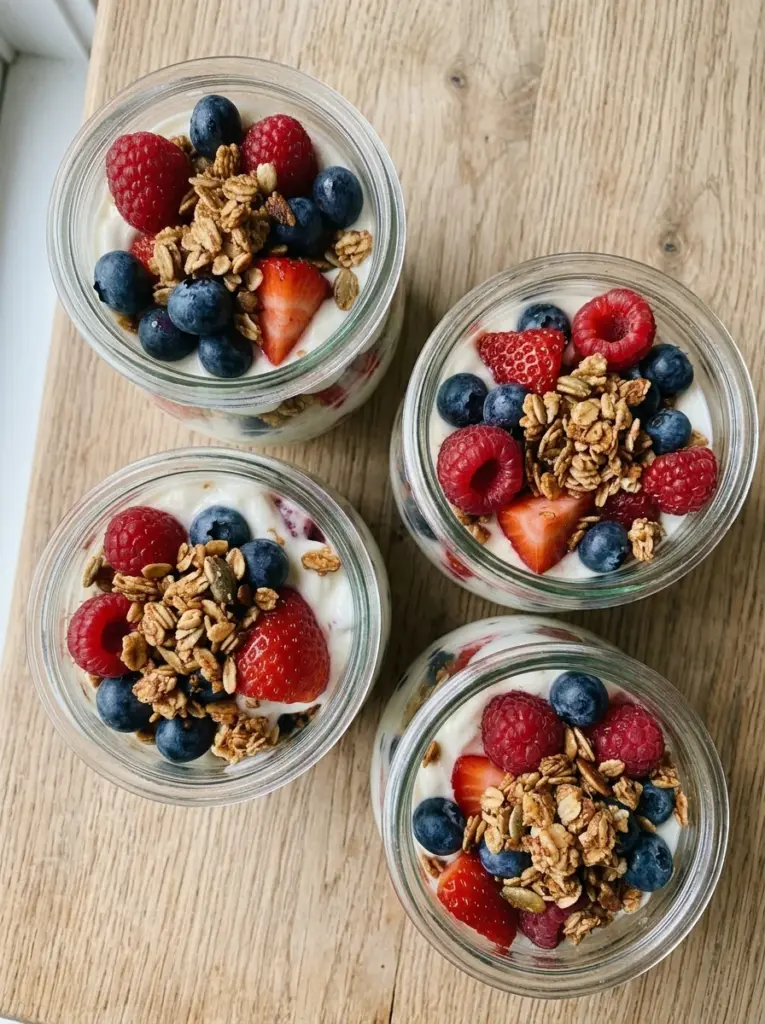
The vessel in which a parfait is assembled matters more than most people realize. A clear glass or jar is not merely aesthetic — it is functional, because the visible layers are part of the experience. A tall, narrow vessel creates dramatic, distinct layers with high visual impact but can make reaching all layers with a spoon challenging. A wide, shorter vessel creates less dramatic layering but allows every bite to easily capture all three components. An 8–12 oz wide-mouth mason jar is the most practical and visually effective option for most settings.
For entertaining, tall stemless wine glasses or clear highball glasses create the most impressive presentation. For meal prep and packed lunches, wide-mouth mason jars with lids are the most practical format. For children, small clear plastic cups or low wide bowls allow them to see all the layers without the risk of broken glass. For a restaurant-style plated dessert, a wide, shallow champagne coupe creates a beautiful, low-profile presentation with maximum visibility of every layer.
Step 5: Layer with Intention
The layering sequence for a great parfait is not arbitrary — it is engineered to ensure that every bite contains all three components in balanced proportion and that the visual presentation is as beautiful as possible through the clear sides of the glass.
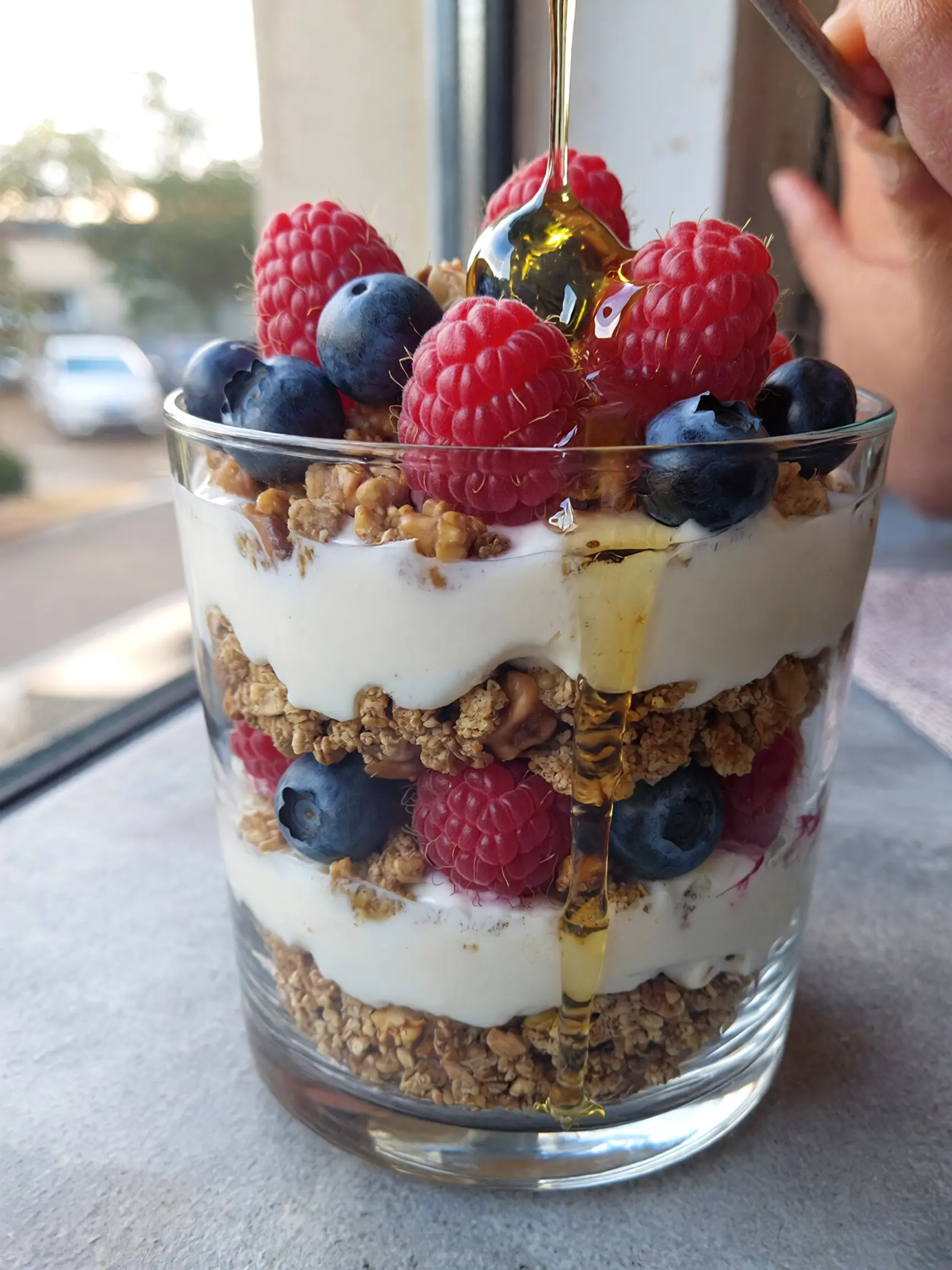
Begin with a generous base layer of the sweetened yogurt — approximately ⅓ cup for a standard 10–12 oz glass. Spread it level and smooth with a small spoon, creating a clean, even white surface. Add a layer of granola — approximately ¼ cup — distributed evenly over the yogurt surface. Press it gently into the yogurt so the clusters have some stability rather than sliding to one side. Add a layer of the macerated berries — approximately ¼ cup — spooned over the granola, allowing some of the berry juice to seep down through the granola layer.
Repeat the sequence: another layer of yogurt, another layer of granola, another layer of fruit. For a 10–12 oz glass, two complete cycles of all three layers is the ideal structure — it provides enough of each component to feel generous while still allowing the top to be above the rim for the final decoration.
Finish the top layer with a final arrangement of the reserved whole berries — placed with intention rather than scattered. Place the most visually striking elements — a whole strawberry, a cluster of blueberries, a perfect raspberry — in the center first, then fill around them with the smaller berries and any finishing elements. Drizzle honey or nut butter over the entire top in a thin, even zigzag. Add a fresh mint sprig for color and fragrance. Scatter cacao nibs, toasted coconut, or bee pollen if using.
Step 6: Serve Immediately or Store Strategically
A freshly assembled parfait is at its absolute peak for the first 15–20 minutes after assembly — the granola is still crispy against the cold yogurt, the berries are at their freshest, and the visual presentation is at its most pristine. Serve immediately whenever possible.
If the parfaits need to sit before serving, keep the granola separate and add it immediately before eating — granola stored in contact with yogurt for more than 20 minutes begins to absorb moisture and softens significantly. This is the single most important storage insight for parfaits: the granola must stay separated from the yogurt until the moment of eating if crunchiness is a priority.
For meal-prepped parfaits destined for the refrigerator, layer the yogurt and fruit only, cover and refrigerate, and store the granola in a small separate container or zip-lock bag alongside. Add the granola layer at the moment of eating. This approach maintains the integrity of every component and produces a refrigerator-stored parfait that is nearly as fresh as one assembled minutes before.
Nutritional Information
Based on one serving — one 10–12 oz parfait with full-fat Greek yogurt, homemade granola with nuts, and mixed fresh berries, without additional nut butter or toppings:
| Nutrient | Amount Per Serving |
|---|---|
| Calories | ~420 kcal |
| Protein | 22g |
| Total Fat | 16g |
| Saturated Fat | 6g |
| Carbohydrates | 52g |
| Fiber | 6g |
| Sugars | 24g |
| Sodium | 140mg |
| Calcium | 240mg |
| Iron | 2.8mg |
| Vitamin C | 28mg |
| Potassium | 520mg |
| Probiotics | Significant (dependent on yogurt brand and live culture content) |
Nutritional Context:
With 22 grams of protein per serving, a yogurt parfait delivers more protein than two large eggs — making it one of the most protein-dense breakfasts in the entire morning meal category.
The full-fat Greek yogurt is the primary protein source, alongside meaningful quantities of probiotics — live bacterial cultures including Lactobacillus bulgaricus and Streptococcus thermophilus — that support gut microbiome health. Research published in the journal Cell Host & Microbe found that a high-fermented food diet significantly increased microbiome diversity and decreased inflammatory markers in human subjects.
The mixed berries contribute anthocyanins — the purple and red pigment compounds that Harvard’s T.H. Chan School of Public Health has linked in multiple large studies to reduced cardiovascular risk, improved cognitive function, and decreased inflammation. The rolled oats in the granola deliver beta-glucan fiber, which the FDA has approved a heart health claim for, recognizing its role in reducing LDL cholesterol. This is a breakfast that works on every nutritional level simultaneously.
Healthier Alternatives for the Recipe
The yogurt parfait is already one of the healthiest breakfast options available. These modifications target specific nutritional goals without compromising the enjoyment that makes the recipe worth returning to.
Maximize Protein: Use Icelandic skyr instead of Greek yogurt — skyr is strained even more thoroughly than Greek yogurt and contains approximately 17–20 grams of protein per 5.3 oz serving, compared to 12–15 grams in Greek yogurt. Stir in a tablespoon of unflavored collagen peptides — they dissolve completely into the yogurt with no flavor impact and add approximately 10 grams of additional protein per tablespoon. Replace the granola’s nuts with hemp seeds — they provide 10 grams of complete protein per 3 tablespoons and distribute evenly through the granola without dominating any single bite.
Reduce Sugar: Use unsweetened plain yogurt without any honey or maple syrup addition, allowing the natural sweetness of ripe fruit to provide all the sweetness the parfait needs. Replace dried fruit in the granola with additional seeds. Use only very ripe, in-season berries — fruit at peak ripeness contains significantly more natural sugar than under-ripe alternatives and requires no additional sweetening. Per-serving sugar reduction compared to the standard recipe: approximately 12–15 grams.
Increase Fiber Dramatically: Stir 2 tablespoons of ground flaxseed into the yogurt base — it distributes invisibly and adds 4 grams of fiber and significant omega-3 fatty acids per tablespoon. Add chia seeds to both the yogurt base and the fruit layer. Use a high-fiber granola that incorporates oat bran alongside rolled oats. Add sliced banana to the fruit layer — one medium banana provides 3 grams of fiber and serves as a natural sweetener that reduces the need for added honey.
Anti-Inflammatory Version: Build the parfait specifically around its most anti-inflammatory components. Use full-fat plain kefir instead of yogurt — it contains a significantly wider range of probiotic strains and has been more extensively studied for gut health benefits. Use wild blueberries rather than cultivated — they contain two to three times more antioxidants per gram than cultivated varieties. Add a pinch of ground turmeric and a pinch of black pepper to the yogurt base — together they provide curcumin in a bioavailable form. Scatter raw walnuts over the top instead of baked granola nuts — the roasting process degrades some of walnuts’ omega-3 content, and raw walnuts are among the most anti-inflammatory foods available.
Lower Calorie Version: Use 0% plain Greek yogurt and reduce the honey to 1 teaspoon. Replace the oil-and-syrup granola with a dry-toasted version — toss the oats and seeds with just the spices and a small amount of egg white (which provides binding without fat) and bake at 300°F for 30 minutes. Increase the fresh fruit proportion and decrease the granola proportion. Per-serving calorie count drops to approximately 280–310 calories while maintaining the full flavor and structural experience of the standard recipe.
Serving Suggestions
Yogurt parfaits are the most format-flexible recipe in any home cook’s repertoire — they adapt to virtually every occasion, time of day, and dietary context with minimal adjustment.
The Classic Breakfast Parfait: Served in a wide-mouth mason jar with homemade granola and seasonal mixed berries, accompanied by a strong cup of coffee or a fresh-pressed juice. This format is the gold standard — clean, beautiful, nutritious, and genuinely delicious. It requires no plates, no silverware beyond a single spoon, and generates minimal cleanup.
The Elegant Brunch Presentation: Assemble individual parfaits in tall, clear wine glasses or champagne flutes. Layer meticulously and finish the top with a deliberate arrangement of fresh berries, edible flowers, a drizzle of raw honey, and a sprig of fresh mint. Serve on a wooden board alongside other brunch elements — fresh pastries, sliced seasonal fruit, soft-boiled eggs. A parfait assembled in a beautiful glass at a brunch table generates admiration before anyone has tasted it.
The Dessert Parfait: Swap the standard fruit layer for a warm berry compote made from frozen mixed berries cooked briefly with honey and a splash of lemon juice until jammy and syrupy. Add a layer of lemon curd between the yogurt and fruit layers. Top with toasted meringue kisses, white chocolate shavings, and crystallized lemon peel. This transformed version is a plated dessert entirely worthy of a dinner party and takes under 10 minutes to assemble.
The Post-Workout Recovery Parfait: Add a scoop of unflavored or vanilla protein powder to the yogurt base, stir in 2 tablespoons of nut butter for healthy fats and additional protein, and top with banana slices and honey rather than a full berry layer. This high-protein, moderate-carbohydrate format is calibrated for post-exercise recovery — it provides fast-digesting dairy protein for muscle synthesis, banana for glycogen replenishment, and fat from the nut butter for sustained energy.
The Kids’ Parfait Bar: Set out all components in separate small bowls — yogurt, granola, and three or four different fruit options — and let children assemble their own parfaits in clear cups. Provide colorful toppings like mini chocolate chips, rainbow sprinkles (in small quantities), sliced banana, and honey for drizzling. Children who participate in building their own food are significantly more likely to eat it enthusiastically — the parfait bar format converts even the most reluctant breakfast eaters.
The Travel-Ready Parfait: Layer yogurt and fruit in a wide-mouth mason jar with a secure lid. Store granola in a small zip-lock bag clipped to the outside of the jar. Eat the parfait at your destination, adding the granola at the moment of eating for preserved crunch. This format survives up to 6 hours of refrigeration without any quality degradation and makes an excellent packed breakfast for commutes, road trips, or school mornings.
The Seasonal Variation Strategy: Change the fruit layer with the seasons and the parfait never becomes repetitive. Spring: sliced strawberries and rhubarb compote with lemon curd. Summer: peaches, fresh blueberries, and wildflower honey. Autumn: sliced figs, pomegranate seeds, and toasted hazelnuts with a drizzle of date syrup. Winter: blood orange segments, candied ginger, and a dusting of cinnamon over the yogurt. The granola and yogurt base remain constant — the seasonal fruit layer is what keeps the recipe perpetually fresh and relevant throughout the year.
Common Mistakes to Avoid
These are the specific errors that most consistently prevent a yogurt parfait from reaching its full potential — each one is easy to avoid once you know what to look for.
Using non-fat or low-fat yogurt: The fat in full-fat Greek yogurt is not the enemy — it is the carrier of flavor, the source of the rich, creamy texture, and the component responsible for satiety. Non-fat Greek yogurt is noticeably thinner, more watery, and more aggressively tart, and it produces a parfait that is less satisfying both texturally and nutritionally. The fat difference between non-fat and full-fat Greek yogurt is approximately 8 grams per serving — a completely reasonable trade for the dramatic quality improvement.
Using store-bought granola without reading the label: Many commercial granolas contain more sugar per serving than a candy bar — upward of 15–20 grams in a ¼-cup serving. A granola with sugar or high-fructose corn syrup as the first or second ingredient will make the entire parfait excessively sweet and nutritionally counterproductive. Always check the label and choose granola with whole oats as the first ingredient and less than 8 grams of sugar per ¼-cup serving. Better yet — make your own.
Assembling too far in advance with the granola in contact with the yogurt: Granola stored against yogurt for more than 20–30 minutes loses its crunch as it absorbs moisture. This is the most common and most avoidable parfait disappointment. Always store granola separately from the yogurt and fruit if the parfait will not be eaten immediately, and add it at the last possible moment before eating.
Using underripe or out-of-season berries: Pale, hard, flavorless strawberries in January are not a substitute for ripe, sweet, local strawberries in June. When fresh, in-season berries are not available, frozen berries that have been thawed and well-drained — or better yet, made into a quick warm compote — are significantly superior to out-of-season fresh berries that taste of nothing. Use the best available fruit for the best possible parfait.
Not sweetening the yogurt base: Plain Greek yogurt straight from the container is pleasantly tangy but lacks the balanced sweetness that makes a parfait genuinely enjoyable rather than merely nutritious. Two tablespoons of honey in 3 cups of yogurt adds approximately 3 grams of sugar per parfait serving — a negligible amount that transforms the eating experience from virtuous to genuinely pleasurable.
Skipping the lemon: A small amount of lemon juice in the fruit layer and lemon zest in the yogurt base adds a subtle brightness that amplifies every surrounding flavor — it makes the berries taste fruitier, the yogurt taste creamier, and the honey taste more floral. It is invisible in the finished parfait but immediately noticeable when it is missing.
Using the wrong glass: Assembling a parfait in an opaque vessel misses the entire point of the layered format. The visual appeal of distinct, colorful layers visible through clear glass is not merely decorative — it creates anticipation and a specific pleasure in the eating experience that a bowl of mixed ingredients cannot replicate. Always use a clear vessel.
Storing Tips for the Recipe
Storing Assembled Parfaits Without Granola: Layer the yogurt base and macerated fruit in mason jars or airtight containers and refrigerate for up to 2 days. The yogurt maintains its texture and the fruit continues to release juice, which pools pleasantly at the bottom of the jar and serves as an additional sauce. Add granola immediately before eating.
Storing the Sweetened Yogurt Base: The honey-vanilla yogurt base keeps in an airtight container in the refrigerator for up to 3 days. Stir briefly before using — the honey can settle slightly during storage.
Storing Homemade Granola: Cool completely before storing. Transfer to an airtight glass jar or container — glass is preferred over plastic because it preserves crunch more effectively and does not absorb the granola’s oils and aromas over time. Store at room temperature for up to 3 weeks or in the freezer for up to 3 months. Frozen granola can be eaten directly from the freezer — it thaws within minutes at room temperature and maintains its crunch perfectly after freezing.
Storing Macerated Berries: The macerated fruit layer keeps in an airtight container in the refrigerator for up to 24 hours. After 24 hours, the berries begin to break down and lose their structural integrity — the texture becomes soft and mushy and the juice becomes excessive. For multi-day meal prep, store the yogurt base and granola prepared in advance and cut fresh fruit each morning — it takes 60 seconds and produces dramatically better results than pre-macerated fruit stored for multiple days.
The Complete Weekly Meal Prep Strategy: On Sunday, bake a full batch of homemade granola (approximately 4 cups), sweeten and vanilla-season a full container of Greek yogurt, and store both in the refrigerator and pantry respectively. Each morning, combine ¾ cup of the prepared yogurt with ¼ cup of freshly cut or thawed fruit and ¼ cup of granola. Total morning effort: 3 minutes. Total result: a breakfast that is nutritionally superior to almost every alternative, more delicious than anything from a café, and significantly less expensive than any purchased option. This is the highest-return meal prep investment in the entire breakfast category.
Conclusion
Yogurt Parfaits are the dessert that is secretly breakfast, the breakfast that is secretly a nutritional powerhouse, and the snack that is impressive enough to serve at a dinner party. These Yogurt Parfaits occupy a unique position in the recipe landscape, being genuinely easy enough for a busy weekday morning and beautiful enough for a special occasion table.
What makes Yogurt Parfaits extraordinary is not any single component but the relationship between them. Cool, tangy, protein-rich yogurt pairs perfectly with the warm, toasted crunch of granola, while fresh berries add bright flavor and natural sweetness. The distinct layers make Yogurt Parfaits especially appealing when served in clear glasses, creating a beautiful presentation with every spoonful.
Make a batch of homemade granola this weekend, sweeten a jar of Greek yogurt, and stock your refrigerator with the freshest berries you can find. Then spend just 5 minutes building Yogurt Parfaits that are both nutritious and genuinely satisfying.
Share your Yogurt Parfaits in the comments below. What fruit combination did you choose? Did you try homemade granola, and what occasion did you make them for? If Yogurt Parfaits have convinced you that the best food is often the simplest, explore our Homemade Açaí Bowls with Tropical Fruit, Chia Seed Pudding with Mango and Coconut, and Overnight Oats with Berries and Almond Butter for more breakfast and snack recipes built on great ingredients, minimal effort, and maximum flavor.
FAQs
Q: What is the best yogurt for Yogurt Parfaits? Full-fat plain Greek yogurt is the best recommendation for Yogurt Parfaits because of its combination of flavor, creamy texture, protein content, and versatility. Fage Total 5%, Chobani Whole Milk Plain, Siggi’s Plain, and Stonyfield Organic Whole Milk Plain are all excellent choices. For dairy-free Yogurt Parfaits, Kite Hill Plain Almond Milk Yogurt and Harmless Harvest Coconut Yogurt are great alternatives.
Q: How do I prevent granola from getting soggy in Yogurt Parfaits? The most reliable solution is to keep the granola separate from the yogurt and fruit until the moment you are ready to eat. For meal-prepped Yogurt Parfaits, store the granola in a small container or zip-lock bag alongside the sealed yogurt and fruit, then add it immediately before serving.
Q: Can I use flavored yogurt in Yogurt Parfaits instead of plain yogurt? Yes, but plain yogurt is usually the better choice. Flavored yogurt can contain more added sugar, while plain Greek yogurt allows the natural flavor of fresh fruit and granola to stand out. For sweeter Yogurt Parfaits, add a small amount of honey or maple syrup along with vanilla extract.
Q: How do I make Yogurt Parfaits for a large group? For a crowd, create a Yogurt Parfait bar with bowls of sweetened yogurt, granola, fresh fruit, and toppings such as honey, nut butter, chocolate chips, toasted coconut, and seeds. Guests can assemble their own Yogurt Parfaits in individual glasses or cups, making this an easy and interactive option for parties and gatherings.
Q: Are Yogurt Parfaits suitable for children? Yogurt Parfaits are a child-friendly option because they are colorful, creamy, customizable, and naturally sweet from fresh fruit. For younger children, break granola into small pieces and choose soft fruit. For babies under 12 months, do not use honey. Children with nut allergies can enjoy Yogurt Parfaits with seed-based granola and nut-free toppings.
Q: What is the nutritional difference between Greek yogurt and regular yogurt in Yogurt Parfaits? Greek yogurt is strained to remove whey, creating a thicker texture and concentrating the protein. It typically provides more protein per serving than regular yogurt and holds its layers more effectively. For this reason, Greek yogurt is an excellent base for Yogurt Parfaits when you want a creamy texture and a more protein-rich breakfast or snack.
Q: Can I make a hot version of Yogurt Parfaits in winter? The yogurt layer should remain cold because heating Greek yogurt can cause it to separate. Instead, warm the other ingredients and serve them over cold yogurt. A warm spiced berry compote and freshly baked granola create a delicious contrast with the chilled yogurt, giving Yogurt Parfaits a cozy variation for colder months.
More Breakfast Recipes to Try
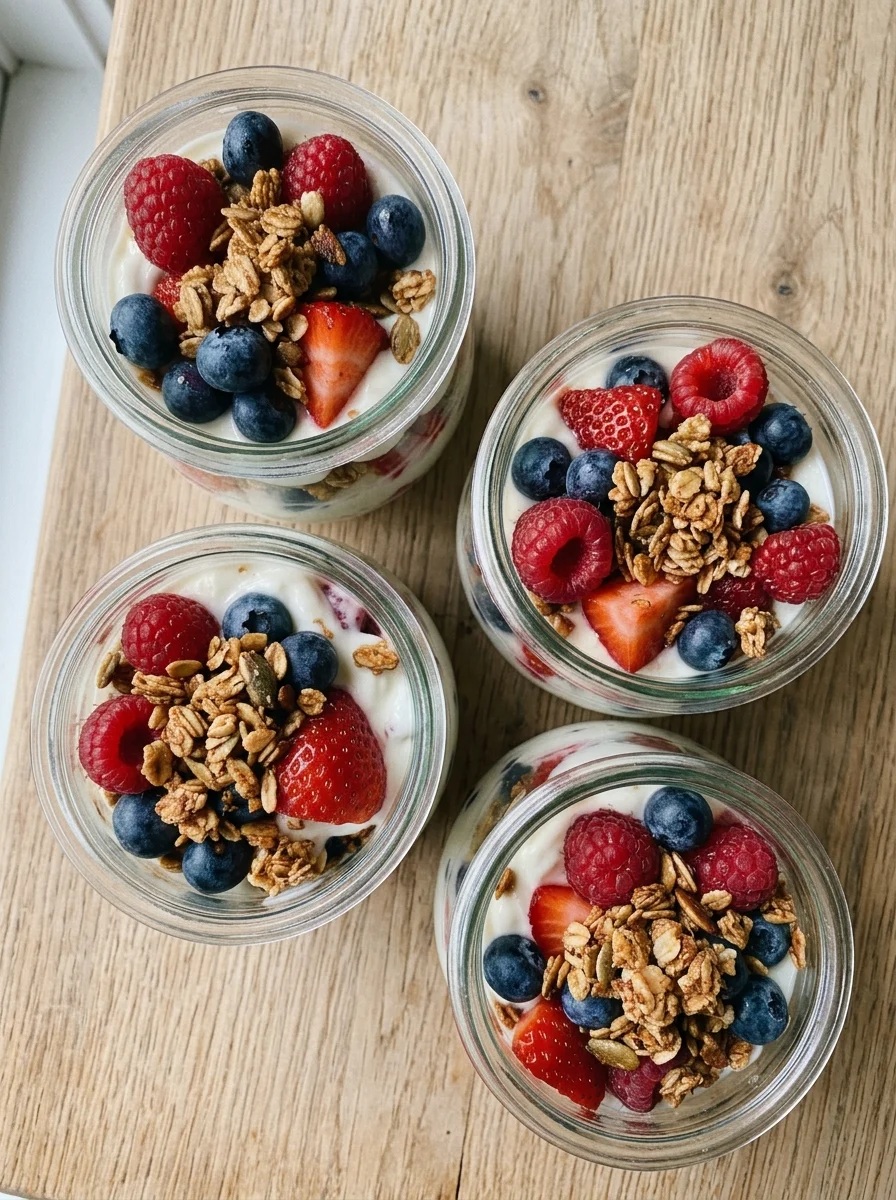

Yogurt Parfaits
Ingredients
Equipment
Method
- Add the Greek yogurt and vanilla extract to a bowl and stir until smooth.
- Spoon a layer of yogurt into the bottom of each serving glass.
- Add a layer of strawberries, blueberries, and raspberries.
- Sprinkle a layer of granola over the fruit.
- Drizzle with a little honey.
- Repeat the layers until the glasses are filled.
- Finish with fresh berries, granola, and a drizzle of honey.
- Add chia seeds if desired.
- Serve immediately or refrigerate until ready to serve.
Notes
Use vanilla Greek yogurt for a sweeter parfait and omit the vanilla extract.
Fresh or thawed frozen berries can be used.
Add sliced bananas, peaches, or mango for more variety.
For meal prep, keep the granola separate until serving.
Store assembled parfaits covered in the refrigerator for up to 2 days.
Enjoying AmandBox? Follow us on Pinterest for more recipes.